

Volatile Acidity: A Number Is Not a Verdict
We can measure volatile acidity to a decimal place. Whether it's a flaw is a different question entirely.

Vinegar is wine that kept going. Same grapes, same yeast, same barrel—give it enough air and enough time and the wrong bacteria, and the thing you meant to cellar becomes the thing you put on a salad. There is no wall between the two, only a slope, and somewhere along it a wine stops being complex and starts being a condiment. The compound doing the work is acetic acid, and the reason volatile acidity, commonly abbreviated as VA, is worth an entire piece is that it is the one wine fault you can put a number on. Brett is something we perceive and rarely measure. The same goes with cork taint. VA is arithmetic, measured in grams per liter (g/L) and written into law. Or so it looks from the outside.
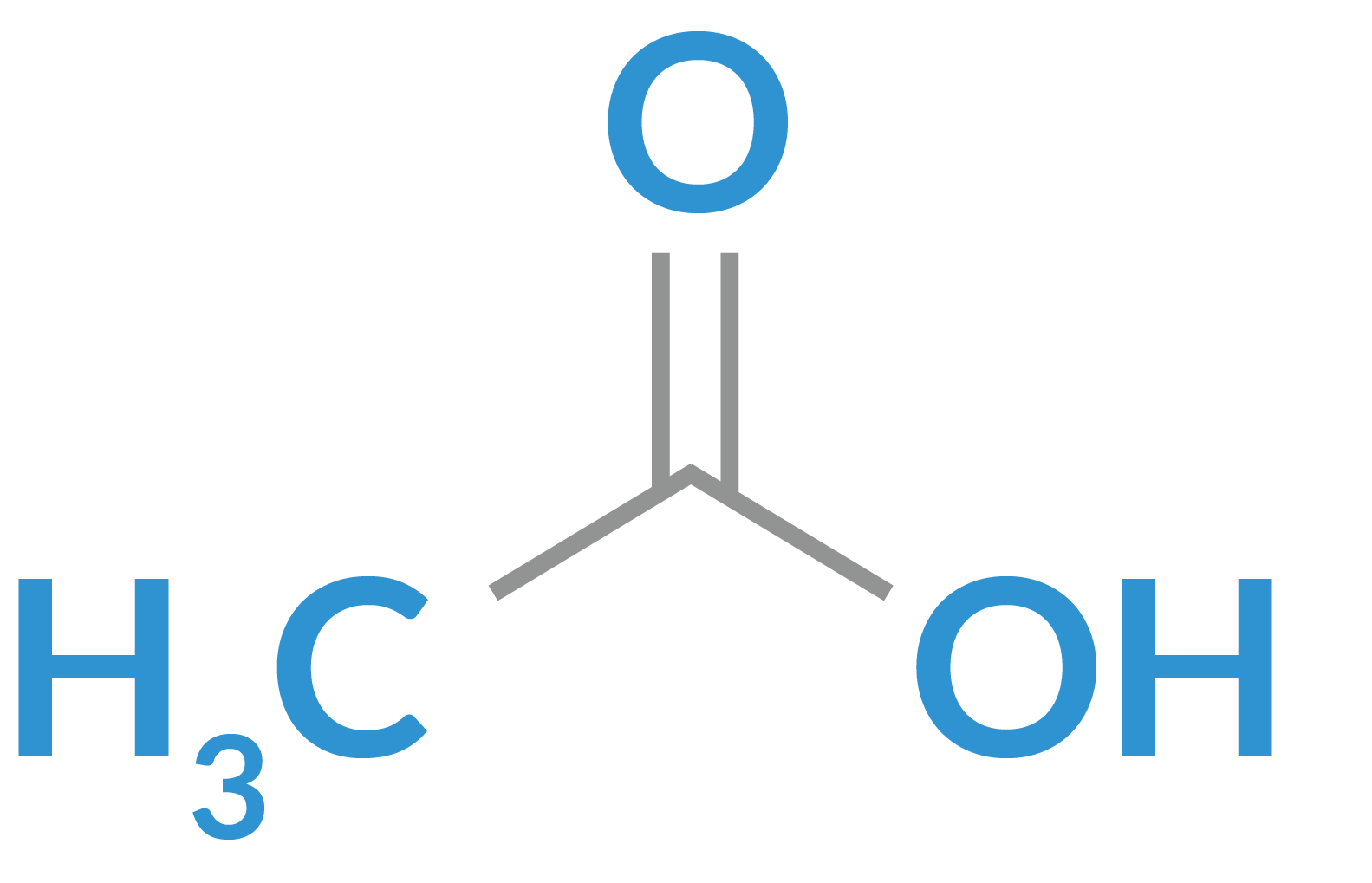
Volatile acidity is the fraction of a wine’s acidity that will leave the glass and reach your nose, and it is dominated by one molecule, acetic acid, the same two-carbon acid that defines vinegar 1. It rarely travels alone. Acetic acid and ethanol undergo esterification, a condensation reaction where an acid and an alcohol shed a molecule of water to form an ester. The ester in this case is ethyl acetate, which smells less like vinegar and more like nail polish remover 1 2. Behind both sits acetaldehyde, the compound ethanol passes through on its way to becoming acetic acid, so a note of bruised apple is often the early warning that worse is coming 1. All three are volatile, which is the whole point of the name: they leave the wine as vapor and reach you mainly through the nose, not the tongue. Acetic acid does bite on the palate as a sharp sourness once it climbs high enough, but VA is something you smell before you ever taste it. Here is the first quiet joke. The standard assay distills the volatile acids out of the wine, titrates them, and reports the result as acetic acid, which is also precisely how the law defines its limit 7 13. Ethyl acetate, though, is a neutral ester rather than an acid, so the titration that anchors the legal figure never registers it 2. Acetic acid is the compound you tend to smell second, and the law measures it to a decimal place. Ethyl acetate is the one you smell first, often at a fraction of the concentration, and it sits outside the number entirely 10 11. The figure on the report is not merely hard to interpret. It is entirely incomplete.
The folk explanation of where VA comes from is that a dirty cellar let Acetobacter loose and a careless winemaker failed to stop it. This is true, however it is only a fraction of the story. Acetobacter does oxidize ethanol to acetic acid, and because it is strictly aerobic it needs oxygen to do the work, which is why a poorly topped barrel is its favorite real estate 3 5. But acetic acid arrives by other roads that have nothing to do with cellar hygiene. Gluconobacter makes it from glucose on damaged and rotten fruit out in the vineyard, before the grapes ever reach a cellar 12. Yeast makes it during fermentation as a normal byproduct. Brettanomyces adds its own. The apiculate yeasts that colonize fruit early throw off ethyl acetate before the cultured strains take over 6. And Saccharomyces makes a great deal more acetic acid when forced to work through a high-sugar must with too little available nitrogen, which is precisely the condition of a botrytized or late-harvest wine 1 4. Sweet wines, in other words, often carry elevated VA not because someone failed but because the style demands the very conditions that produce it. The number on the lab report tells you that acetic acid is present, but it doesn’t tell you which of half a dozen unrelated processes put it there, and it certainly doesn’t tell you that anyone was careless.
The law, to its credit, tries to draw a line anyway. In the United States the ceiling is 1.4 g/L for red wine and 1.2 g/L for white, calculated as acetic acid and exclusive of sulfur dioxide 7. The OIV sets a general maximum of 20 milliequivalents per liter (mEq/L), which works out to roughly 1.2 g/L 8. The European Union splits it by color, 20 mEq/L for reds and 18 mEq/L for whites and rosés, and then does something revealing: it lets the limit climb with alcohol, granting high-strength aged wines more headroom on the theory that they can carry it 9. Read that last clause again, because the regulators have quietly conceded the whole game. If the legal threshold has to scale with the wine, then the legal threshold was never a statement about quality. It is a statement about compliance. A wine can sit comfortably under the threshold and read as nail polish remover, and another can press against it and read like lift and energy.
Which brings us to the part everyone wants and no one can supply, the number at which VA turns from interesting to wrong. The detection thresholds exist and are roughly known. Acetic acid becomes perceptible somewhere between 0.6 and 0.9 g/L, depending on the wine, while ethyl acetate announces itself at 150 to 200 milligrams per liter, which is why we typically perceive it first 10. Below about 0.7 g/L, with ethyl acetate kept low, acetic acid can read as complexity rather than flaw 6. But those figures dissolve the moment you try to use them, because perception is not a property of the molecule alone. Sugar and alcohol mask VA while acid and tannin sharpen it 2. The same 0.8 g/L that wrecks a delicate dry white can disappear into a ripe sixteen-percent red. Fault and feature were never two regions on a number line. They are a relationship between the molecule, the wine it is dissolved in, and the person doing the smelling.
So the measurement was honest the whole time, and we were the ones overstating what it meant. It tells you how much acetic acid is in the glass, to a decimal place, with real precision. It does not tell you, has never told you, and cannot tell you whether the wine is any good. The genre keeps citing the number as if it were a verdict. It was only ever a measurement. VA gets called the dishonest fault, the spoilage that dresses itself up as complexity and fools the credulous. It might be the most honest thing in the glass. It is the only fault that gives you a number, and then waits to see whether you will mistake the number for a verdict.
—
Road Less Poured publishes every Thursday morning: one grape, region, or producer that deserves more of your attention. Every so often, between drops, a piece like this one on the science, the kind of thing that explained your wine diamonds last time. Subscribe so the next one doesn't slip past your threshold. And remember, the number never tells you whether a wine is faulted; you do. What are your thoughts on VA?
Waterhouse Lab, UC Davis. "Volatile Acidity," What's In Wine. https://waterhouse.ucdavis.edu/whats-in-wine/volatile-acidity
Waterhouse, A. L., Sacks, G. L. & Jeffery, D. W. Understanding Wine Chemistry. Wiley.
Bartowsky, E. J. & Henschke, P. A. (2008). "Acetic acid bacteria spoilage of bottled red wine — a review." International Journal of Food Microbiology 125(1): 60–70. DOI: 10.1016/j.ijfoodmicro.2007.10.016. https://www.sciencedirect.com/science/article/abs/pii/S016816050700685X
Bely, M., Rinaldi, A. & Dubourdieu, D. (2003). "Influence of assimilable nitrogen on volatile acidity production by Saccharomyces cerevisiae during high sugar fermentation." Journal of Bioscience and Bioengineering 96(6): 507–512. DOI: 10.1016/S1389-1723(04)70141-3. https://www.sciencedirect.com/science/article/abs/pii/S1389172304701413
Drysdale, G. S. & Fleet, G. H. (1988). "Acetic Acid Bacteria in Winemaking: A Review." American Journal of Enology and Viticulture 39(2): 143–154. DOI: 10.5344/ajev.1988.39.2.143. https://www.ajevonline.org/content/39/2/143
Zoecklein, B. Enology Notes #158. Virginia Tech. https://enology.fst.vt.edu/EN/158.html
27 CFR §4.21, Standards of Identity for Wine. https://www.ecfr.gov/current/title-27/chapter-I/subchapter-A/part-4/subpart-C/section-4.21
OIV. Compendium of International Methods of Analysis of Wines and Musts, Annex C: Maximum Acceptable Limits. https://www.oiv.int/standards/compendium-of-international-methods-of-wine-and-must-analysis/annex-c/annex-c-maximum-acceptable-limits-of-various-substances
Commission Delegated Regulation (EU) 2019/934, Annex I, Part C. https://eur-lex.europa.eu/eli/reg_del/2019/934/oj
"Volatile Acidity: A Little Goes a Long Way." WineMaker. https://winemakermag.com/technique/volatile-acidity-a-little-goes-a-long-way
Penn State Extension. "Volatile Acidity in Wine." https://extension.psu.edu/volatile-acidity-in-wine
Oklahoma State University Extension. "Volatile Acidity in Wine." https://extension.okstate.edu/fact-sheets/volatile-acidity-in-wine.html
OIV. Compendium of International Methods of Analysis of Wines and Musts, Volatile Acidity (OIV-MA-AS313-02), Type-I method. https://www.oiv.int/public/medias/3732/oiv-ma-as313-02.pdf