
Thursday Wine: Guy Breton
The soft-spoken revolution in Beaujolais

For week 11 of Thursday Wine, I’m taking a brief detour from exploring lesser-known varietals and regions to spotlight a winemaker whose work reshaped how I understand an entire appellation. The winemaker is Guy Breton, and the region is Beaujolais—Burgundy’s granitic enclave devoted to Gamay.
Before we get to Breton, it helps to understand the landscape he helped redefine. For many drinkers, Beaujolais was long synonymous with Beaujolais Nouveau, the early-release wine made from whole, uncrushed clusters through 100% carbonic maceration, an anaerobic process that produces intensely fruity, low-tannin wines often marked by notes of banana and bubble gum. In the late 90s and early 2000s, mass-market Nouveau flooded the U.S., and while it raised Beaujolais’ visibility, it also cemented an image of the region as a source of simple, low-quality wines lacking nuance and ageability.
Over the past decade, however, that perception has shifted dramatically. A new generation of growers has taken the reins of family estates, pushing quality higher on two fronts. First, from Juliénas and Saint-Amour in the north to Brouilly in the south, producers are emphasizing cru-level terroir, crafting wines that express site, soil, and structure rather than Nouveau’s cheerful immediacy. Second, many are embracing organic, biodynamic, and low-intervention farming, elevating craft and authenticity and positioning Beaujolais as a region capable of far more depth than its old reputation suggested.
And this is exactly where Guy Breton enters the picture, as one of Kermit Lynch’s now-famous “Gang of Four,” the group of vignerons who helped spark this shift long before it became fashionable. Lynch coined the moniker to highlight the work of four producers—Marcel Lapierre, Jean Foillard, Jean-Paul Thévenet, and Breton—whose wines stood in stark contrast to the bulk, low-quality bottlings that defined the region at the time. The strategy worked. Lynch is widely credited not only with championing but also importing these wines to the U.S. market, introducing many drinkers to Cru Beaujolais as a serious, terroir-driven alternative that could hold its own alongside the elegance of Burgundy (and at a fraction of the price!).
Like many wine drinkers, my first impression of Beaujolais was shaped by inexpensive, forgettable Beaujolais Nouveau—cheerful, fruity, and not much more. Even when Kermit Lynch and others began championing Cru Beaujolais, I explored the wines with curiosity but didn’t immediately gravitate toward them; they were enjoyable when poured, but not something I sought out. That changed during a 2023 trip to Lyon, the de facto capital of Beaujolais, which happened to coincide with the third Thursday in November, the annual release of Nouveau. The exuberance surrounding both Nouveau and Cru Beaujolais was palpable!
At a small wine bar called Illustre, a sommelier (Bonjour Matthias!) poured me my first glass of Guy Breton’s Régnié, and suddenly the region snapped into focus. His wines were everything Nouveau wasn’t: light, perfumed, and complex, humming with crunchy red fruit, bright acidity, flinty minerality, and nearly tannin-free, a style that mirrors Breton’s own distaste for tannin. It was the first time I truly understood the spirit and potential of Cru Beaujolais, and it’s why Breton’s wines have stayed with me ever since.
If you want to truly experience Beaujolais, a trip to Lyon is essential. There’s a reason locals refer to Beaujolais as le troisième fleuve (“the third river”)—its wines flow into the city as naturally as the Saône and the Rhône.
I tasted so many spectacular wines on that trip—from the lighter, perfumed wines of Fleurie and Chiroubles to the bolder, more structured wines of Morgon and Moulin-à-Vent—but none were as profound as those from Guy Breton. When I returned home, I found myself spending weeks reading about him and tracking down his bottles, trying to understand the style that had captivated me so completely.
Breton is known by his friends as P’tit Max, which is not a comment on his stature, but simply because his father’s name is Max, making him “Little Max.” He took over his family’s estate from his grandfather in 1986. Until then, the domaine had sold its fruit to cooperatives focused on producing a uniform, commercial style of Beaujolais, the very model that fed the region’s negative reputation.
Under the guidance of Jules Chauvet, the influential négociant, winemaker, and early voice of what became the natural wine movement, Breton and the other three members of Kermit Lynch’s “Gang of Four” set out to reclaim a more authentic expression of the region. They chose to work with old vines that naturally produced lower yields, abandon synthetic herbicides and pesticides, rigorously sort fruit to keep only the healthiest clusters, use little to no sulfur, and eliminate chaptalization along with fining and filtering. The goal was simple but radical: let each terroir and vintage speak for itself.
Breton differs from the others in one key way: he has famously said he dislikes tannins in wine, and his winemaking reflects that preference. He relies solely on indigenous yeasts, favors cold fermentations that preserve aromatics and soften extraction, and almost always uses 100% whole-cluster fermentation. If oak appears at all, it’s neutral, some of it repurposed from the famed Burgundy estate Domaine de la Romanée-Conti.
Whole-cluster fermentations naturally create an environment for semi-carbonic maceration. When intact bunches are placed in a tank, the weight of the fruit crushes some grapes at the bottom, starting a traditional fermentation. The CO₂ produced rises and displaces oxygen, creating anaerobic pockets where intact berries undergo carbonic maceration. The result is a lift of bright red fruit without tipping into the banana or bubble gum notes associated with full carbonic maceration.
The result of Breton’s approach is wines that are lighter in color, lighter in body, higher in acidity and perfume, and almost devoid of perceptible tannins. When I meet white-wine drinkers who claim they don’t enjoy reds, a bottle of Breton almost always changes their mind.


And finally, this brings me to the wine I’ve chosen for this week: the 2023 Cuvée Marylou, tasted from magnum—a perfect expression of everything Breton values in Gamay.
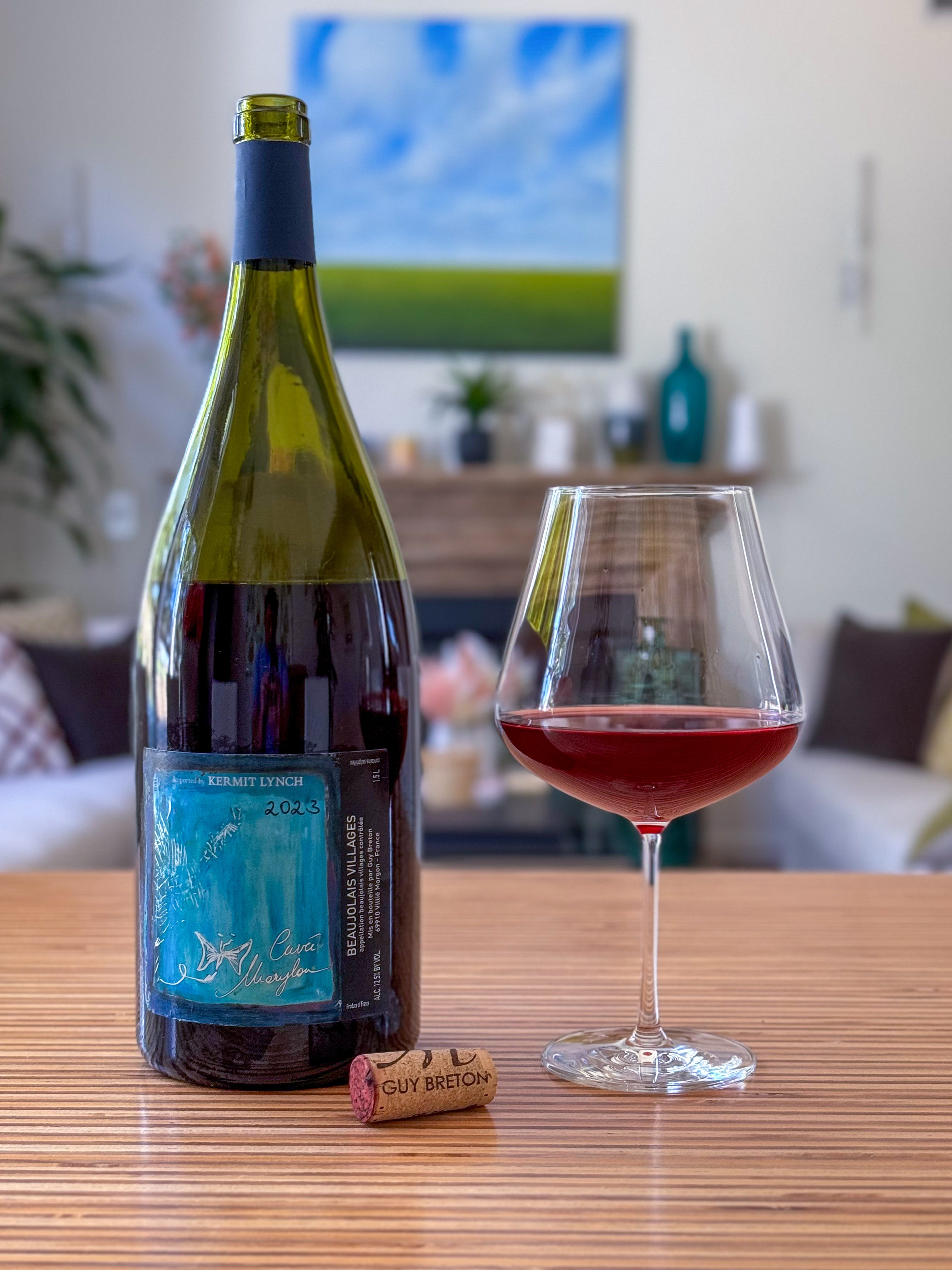
In the glass, the wine is a pale, hazy ruby—the slight cloudiness a natural result of its unfined, unfiltered style. The nose opens with gently underripe strawberries and raspberries, a whisper of wet stone, and a faint floral lift. There’s no perceptible trace of oak.
On the palate, the acidity is lively and bright, carrying crunchy red fruit—think raspberries and pomegranate—into a soft, earthy mid-palate. As expected, the tannins are barely perceptible, giving the wine its characteristic weightlessness and easy drinkability, and the acidity will have you going back for seconds!
At just under $30 for a 750ml bottle (about $65 for a magnum), Marylou remains one of the best value introductions to Guy Breton’s style. It’s my go-to wine for parties: food-friendly, crowd-pleasing, and joyful without breaking the bank.
Tasting Marylou now, I’m brought right back to that night in Lyon when a sommelier first poured me a glass of Breton’s wine and the entire region came into focus. This bottle carries that same clarity—joyful fruit, featherlight texture, an ease that feels almost self-assured. If Beaujolais is the third river of Lyon, then Breton is one of the currents that gives it energy and direction. And if you haven’t tried his wines, I urge you to do so. You can thank me later!
—
If you enjoyed learning about Guy Breton and the wines of Beaujolais, I hope you’ll consider subscribing. I publish an always free weekly post about lesser known varietals and regions, or winemakers, like Breton, that are changing the landscape of wine in their region. As always, I’d love to hear from you if you have suggestions for topics, comments, or questions! Thanks for reading and may your 2026 be filled with love, laughter, and great wine!